Sustainable Tourism Transformation: Unveiling the Power of ESG Implementation

Discover how Environmental, Social, and Governance (ESG) principles are revolutionizing the tourism industry, driving sustainability through strategic implementation, and shaping a greener future for travel.
The significance of sustainability in the realm of tourism has evolved beyond a mere buzzword to become a crucial force shaping the industry’s landscape today. The intertwining of ethical considerations and financial viability has propelled sustainable tourism to the forefront of global conversations. At the heart of this transformative journey lies the concept of Environmental, Social, and Governance (ESG) criteria – a navigating tool steering businesses toward a harmonious coexistence with the environment and society they operate within. Read on to find out the intersection between ESG and tourism.

(Save the environment – Photo by Gabimedia on Pixabay)
ESG goes way beyond ticking boxes. It is about making real change – not just for the company but for our planet too. It is all about creating lasting impacts that boost value and help things grow. While doing all that, we also ensure our environment and communities stay strong and healthy.
Undeniably, ESG integration fuels a paradigm shift for businesses aiming to achieve sustainable tourism goals. By systematically incorporating environmental, social, and governance factors, businesses can transform into agents of change while reaping the benefits of long-term success. When businesses truly embrace and act upon ESG, they transcend profit-making boundaries and emerge as the pioneers of an ethically sound and environmentally conscious tourism industry.

A person holding a green plant (Photo by Akil Mazumder on Pexels)
ESG reporting constitutes a fundamental aspect of the journey toward sustainability for every tourism business. It is about compiling and sharing precise data to ensure transparency and facilitate well-informed decision-making for management.
Key Performance Indicators (KPIs) focused on environmental impact play a pivotal role in assessing a company’s commitment to sustainability. For instance, hotels and resorts report on their energy consumption reduction initiatives, showcasing the installation of energy-efficient lighting systems and solar panels. These metrics demonstrate their efforts to reduce carbon footprint and set benchmarks for others in the industry.
Measuring social and community contributions is another crucial aspect of ESG reporting. Tourism businesses often engage in initiatives that promote local communities’ well-being. Examples include funding educational programs for local children, supporting local artisans, and partnering with community-driven conservation projects. These efforts can be quantified through metrics such as the number of community members employed or the funds invested in community development. By transparently reporting these metrics, companies showcase their positive impacts beyond mere profit generation.
Meanwhile, governance and ethics metrics ensure companies adhere to high ethical principles and transparent practices. Companies can provide information about diversity and inclusion efforts, board composition, and mechanisms for preventing corruption and other unethical practices. Disclosing these measures not only helps businesses to build trust with stakeholders but also attract socially responsible investors.
ESG certifications and industry frameworks enhance credibility and guide tourism businesses toward practicing and reporting sustainability initiatives. Organizations like Global Sustainable Tourism Council (GSTC), EarthCheck, Rainforest Alliance, Travelife, B Corp Certification, and more offer certifications specifically tailored to tourism. These encompass environmental conservation, social responsibility, and economic viability. Meanwhile, organizations like Green Key and Carbon Neutral Certification concentrate on sustainable operation, carbon offsetting, and eco-friendly design. These organizations play a global role in validating sustainability efforts, showcasing businesses’ commitment to responsible practices, and attracting conscientious travelers and investors.

A group of colleagues working together in a green office (Photo by Alexander Suhorucov on Pexels)
Some of the main ESG tourism applications that can be seen are related to big hotel chains, such as Marriot, Hilton, and Accor.
The success of these ESG tourism leaders can be attributed to several factors driving their commitment to sustainable practices: Firstly, amidst growing concern over climate change and its impact on the planet, hotels have recognized the importance of embracing environmental responsibility. By actively participating in the ESG movement, they demonstrate leadership in addressing environmental challenges and meeting the expectations of eco-conscious guests seeking accommodation at environmentally-friendly establishments.
Secondly, hotels have realized that social responsibility is not just a moral obligation but also a shrewd business strategy. In today’s consumer landscape, individuals prioritize supporting companies that prioritize their employees’ well-being and contribute positively to the communities they serve. By incorporating ESG initiatives that emphasize employee welfare, diversity, and local community support, hotels cultivate a positive and compassionate brand image that resonates with both their employees and guests. The symbiotic relationship benefits all parties, establishing a mutually beneficial atmosphere.
Lastly, embracing ESG practices transcends merely altruistic motivations; it presents a pragmatic financial advantage for hotels. By adopting energy-efficient measures and waste reduction initiatives, hotels can realize substantial cost savings in the long term. Additionally, committing to green and responsible practices enhances their appeal to investors actively seeking ethical and sustainable investment opportunities. Consequently, hotels find themselves simultaneously contributing to a better world and securing their financial future, making adopting ESG principles an irresistible and fruitful choice.
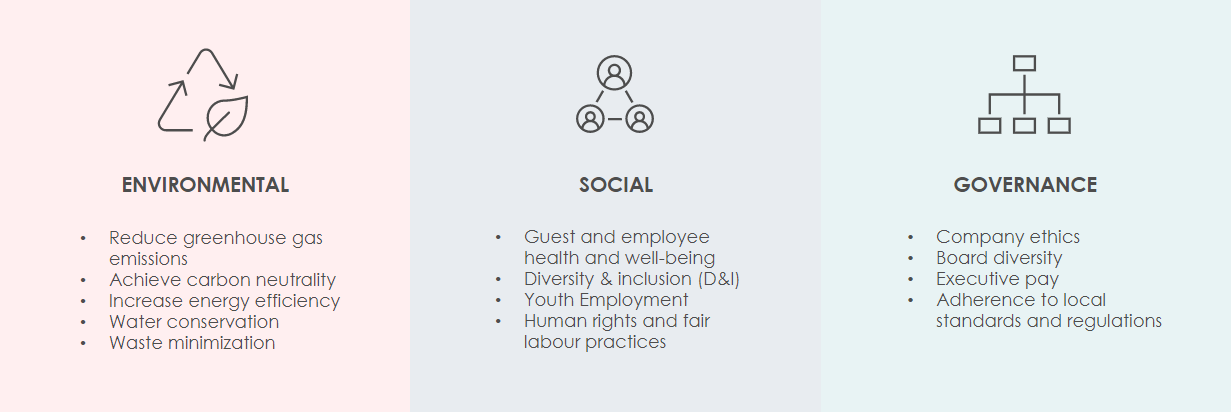
ESG key example metrics (Photo by Own Illustration cited in EHL Insights)
However, this framework isn’t without essential downsides. Here are some important disadvantages to acknowledge:

(Photo by MicroStockHub on Istockphoto)
While ESG reporting initiatives already exist, they lack standardization, limiting comparability and scalability across organizations. To address this, the United Nations World Tourism Organization (UNWTO) is collaborating to develop a harmonized ESG framework to serve as a tourism business reference.
To support evidence-based decision-making, UNWTO has developed the Measuring Sustainability in Tourism (MST) Framework. This framework integrates statistics on tourism’s economic, environmental, and social dimensions, providing guidance on measuring tourism across various scales and dimensions. It aims to create a consistent approach to organizing data and indicators to support ESG reporting for individual companies and the entire tourism sector.
Following the initial drafting of the ESG framework for tourism businesses, at least six pilot studies will be conducted using the draft framework. These pilots will involve businesses from different industries and help develop ESG reports while assessing capacity gaps in ESG reporting.
To conclude, ESG principles are at the forefront of revolutionizing the tourism industry, driving sustainability, and shaping a greener future for travel. By supporting destinations and businesses that prioritize ESG principles, you’re not just exploring the world but contributing to its preservation. Join us in advocating for responsible and sustainable tourism. Share this message, choose eco-conscious travel options, and let’s collectively shape a greener future for our planet.